I am taking bookings in San Francisco November 9-12, meeting folks at my hotel in Fisherman's Wharf for counsel, bodywork, energy work, yoga, and meditation. We can talk about what is afoot in your living, create you a personalized guided meditation or bring healing attention to your body. Sometimes folks aren't quite sure what they want, they just feel a draw to connect – that's fine! We can decide together how best to use the time in the moment. Here's my Calendly.
Beloved friends,
The rains have arrived in force this week, so perfect for the coming of Samhain – if you aren't familiar, this is the Celtic name for the midpoint between the autumn equinox and the winter solstice, which falls at Halloween. I'm lying on the couch in the sunroom right now, listening to the water streaming over the metal roof and tumble down the gutters. It feels like a blessing. During the dry summer and early autumn, the evergreens grow pale and wilt; they are growing greener now, and perking up. Peak leaf-fall is afoot, too. Most of this forest is evergreens, but there are some deciduous trees: alder, willow, cherry, and maple. We don't get the wild diversity of colors I saw while visiting my family on the East Coast a couple weeks ago, but there is a lot of gold blazing on the hillsides, and the first storms bring down vast quantities of burnt orange cedar needles.
I live in a rural residential neighborhood that basically consists of two winding roads with a few little offshoots; a few dozen homes. There are a few Bigleaf maples along the road and I adore scuffing through the great drifts of gigantic golden leaves – each Bigleaf maple leaf can be as big as your face! The mixture of the growing-more-verdant evergreens and understory with the golden leaves and orange needles makes this season blazing delight, even under the grey skies. I've learned to sop up that green as a nourishment when the grey is afoot. I'm aquiver with excitement about the mushrooms to come!
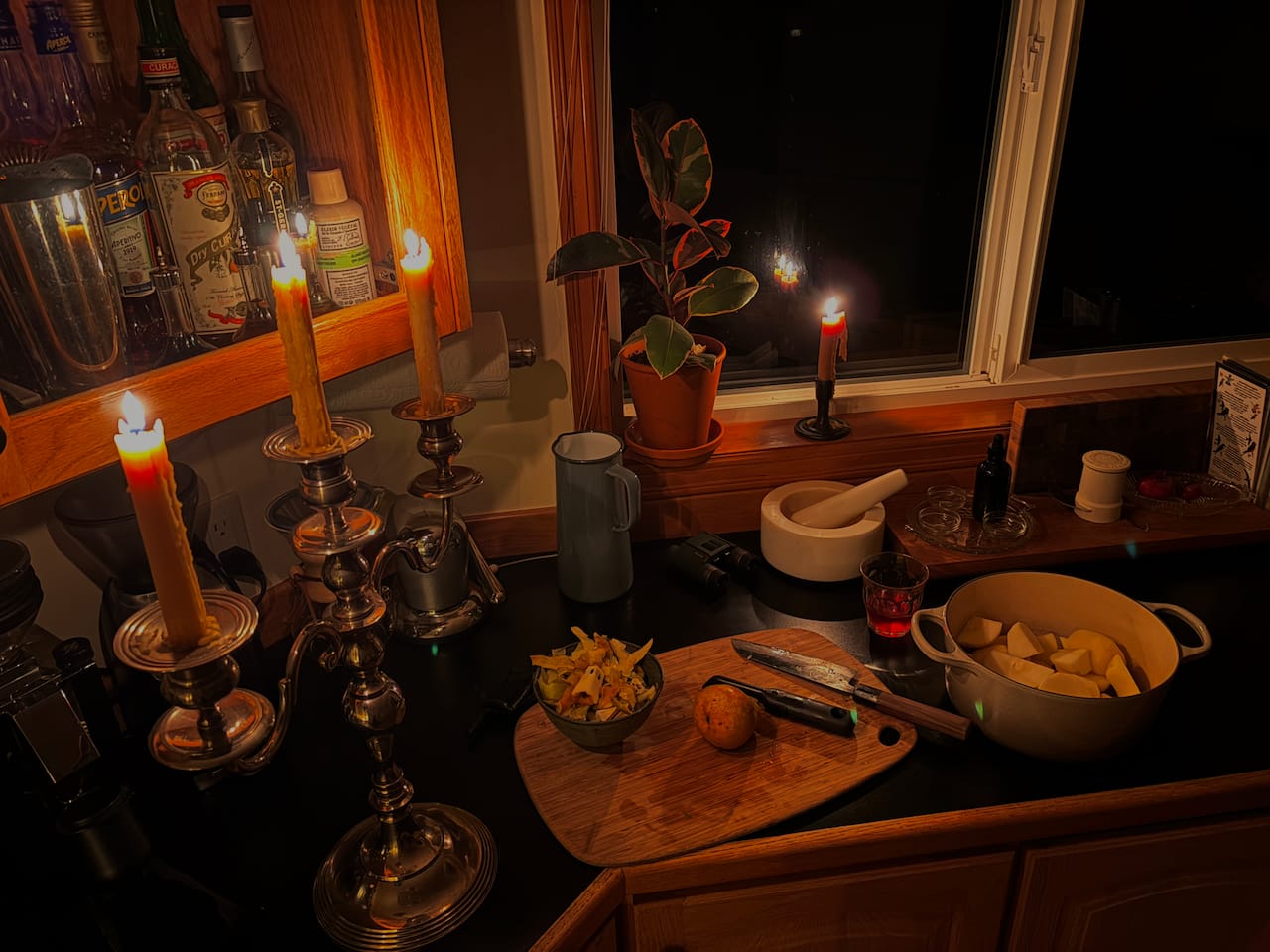
The darkness is growing, too. The photograph atop today's missive was taken when I paused to jot a tiny poem; almost a haiku, but not quite, and I don't want to squash it to make it one.
days before Samhain
awake before dawn
peeling pears from my neighbors' tree
by candlelight. ahhh.
It looks like there's just one fish left in my little pond. Oh how I have loved the pond! In June I bought seven medaka, Japanese rice fish, to eat the mosquito larvae but I've only seen one at a time for a few weeks now, and since they are schooling fish, I think this means the birds or raccoons have eaten the rest. Happily, I have a friend who is raising medaka and he's kindly agreed to take mine on so that they are not left alone – I can't leave just one of a schooling fish alone; that's unkind – and set me up with more come springtime.
I think I figured out the cacophony of Steller's jays while we were away – since our return, our usual visitor, who we simply call Jay, has been accompanied more often by the second bird we'd seen a few times before. The second bird is smaller and less bold, more likely to linger back in the trees while Jay comes to the deck rail for peanuts. It occurred to me to look it up and – yup, all corvids are socially monogamous and genetically promiscuous. That means they have a steady, lifelong nesting partner, but mate with other birds. I think that Jay has been coming all along with his partner. We're calling her Stella.
Last Saturday was a banner day for birding: Northern flicker, Pileated woodpecker, Downy woodpecker, and a new lifer for me: Red-breasted sapsucker. The pair of doves are still here; one spent a long time lingering in the net under the seed feeder one afternoon and a long time in the water offering on a stump out back yesterday. There's a new buck around; we've seen him many times this week. He has a left antler, but has lost his right. He seems to like the meadow beside our house just now.
In the life of the mind: my current Workshop for Living, The Story of Belonging, is into its third month now and I am so lush with the sense of belonging. I'll be sharing some of the fruits of that work here soon, and we'll be carrying this topic on into the new year. I finished Becky Chambers's new novel When You Wake, Break the Shell; it was charming and atmospheric. I feel obliged to warn you that it has a cliffhanger ending, though if you love Becky's hopepunk, you'll be glad to nestle in her world a bit. I've finally cracked Tyson Yunkaporta's Sand Talk and oh. Have you read it? This is one of the higher compliments I can pay a book: I paused in reading the ebook to wait for a hard copy to arrive because I want to read it on paper so I am building a physical relationship to the text.
 Tyson Yunkaporta

A couple of my favorite passages to try to lure you into reading with me:
"For each chapter, I carved the logic sequences and ideas arising from these yarns into traditional objects before I translated them into print. I did this to prevent my oral culture perspective from becoming fragmented and warped as I wrote." and he describes each object as we flow.
and
"I use many other terms that I don't particularly like, such as 'Dreaming' (which is a mistranslation and misinterpretation), because a lot of the old people I respect, and who have passed knowledge on to me, use these words. It's not my place to disrespect them by rejecting their vocabulary choices. I know and they know what we mean, so we might as well just use those labels. In any case, it is almost impossible to speak in English without them, unless you want to say, 'suprarational interdimensional ontology endogenous to custodial ritual complexes' every five minutes. So 'Dreaming' it is."
The veil is thin at Samhain, we say. What is life? I wonder, I wonder.
Ahhhh. Join me?
Love,
Dahlia
Resources
Oh, the Mystery
I've mentioned before the University of Virginia's Division of Perceptual Studies. They say that they are "a research group devoted to the rigorous evaluation of empirical evidence for extraordinary human experiences and capacities. The primary focus of DOPS is investigating the mind's relationship to the body and the possibility of consciousness surviving physical death. In general, this process involves studying phenomena that challenge mainstream scientific paradigms regarding the nature of human consciousness." They collect, in particular, stories of children who have memories of past lives. These tend to arise in children aged 2-5 and fade by age 7. This... is a place that really challenges me to walk my talk as an active agnostic, my commitment to not-knowing. I have this lovely mystic-animist-devotional-agnostic thing where we arise and we are cells in the life of the Earth and cosmos and we return and... then there are the children who wake, crying, asking for their own children, who they remember. What... IS that?! I try to listen. I try to wonder. My inner rationalist is deeply unsettled by this while my inner mystic is making popcorn and pulling up a chair. I'm telling you all this because this group, which has been around for decades and has tracked down the memories of many of these children to correlate them to actual people from the past (!!!) has released a new set of findings: when the people whose past lives the children are remembering died unexpectedly, the time between their death and this child's birth is shorter. And “The effect remained even after we accounted for several cultural and psychological factors, and it was actually stronger in families whose religions did not support reincarnation,” said UVA researcher Philip Cozzolino, PhD. “These results do not support the idea that social beliefs are driving this pattern.”
* whimper *
I do not know. It is not my job to know. It is my job to love life and wonder.
Speaking of Mystery
Have you watched the video for Aldous Harding's "The Barrel"? I'm a great lover of the genre often called freak folk, as you might imagine, but I don't watch a lot of videos, so I was grateful to Molly for bringing this up in the Workshop last week.
Here are the lyrics. And if you share my love for reading other people thinking about the things we are thinking about, here is an essay by Claire Maybe of Flying Nun, a New Zealand record store, which I quite dug: THE FERRET & THE EGG - A FORENSIC READING OF THE BARREL BY ALDOUS HARDING.
Resistance
Darling, have you voted? VOTE EARLY. Ask your friends if the voted. Ask your elders if they need a ride. Offer to share your thoughts on the downballot nitty-gritty you took the time to research.
If you want to do more, Amplifier Army is a group of folks taking inspiration from Lula's Army in Brazil to use social media to spread the active movement against fascism. You can sign up for a training on social banking – using coordinated group action via social media – to get. people. thinking and doing here.
If you're an Instagram user, here's a reel on the topic you can learn from and/or share onward.

Supporting me in supporting you
This is entirely human work – my work, done by hand, with my own mind and heart. I do not have an AI. The half day I devote to creating this each week is a labor of love for which I earn about $15/hr. You can chip in on giving me a raise with a one-time donation, or by upgrading to a paid subscription for as little as $5/month.
If you shop at Bookshop.org from links in this newsletter or my bookshop I will receive a commission of 10%. If you buy any book after starting at my shop I'll receive a commission even if those books aren't in my shop!
Sharing my newsletter is a huge gift, too! The wider my reach, the more people are likely to offer support.
If you are a supporter, thank you; I am honored and humbled by your willingness to support my work in the world.