When I tell people that one of my favorite things these days is cold plunging in the Puget Sound it is common for them to respond, "Oh, I don't like to be cold." I don't think that cold plunging is for everyone. We are so varied! Cold plunging is counter-indicated for some people in their particular health. And of course some folks just don't dig it. I promise that is not an essay in which I try to convince you to cold plunge, darling.
I don't like to be cold either! I also don't like to be hot. Living in the tropics for 5 years, in the peak of my perimenopausal metamorphosis, no less, taught me that I do not love to be hot. It was February when I moved to Washington a few years ago. Every person who learned I had come from Mexico, each in their personal experience of the muddy icy it's-been-dark-and-grey-for-seemingly-ever end of PNW winter, said to me: "You must be so sad to be here in the cold!" But I was not. I found it incredible to wake every day and consider how many and what shape of layers of fluffy warmth to apply to my body. It was weird to get used to the weight of clothing after years wearing as little as possible, but waking to find that my body was not sweaty, sticky, or itchy was a joy again and again.
I like to be comfortable. Most of us like to be comfortable! Turning toward the sea, both to sail and to cold plunge, are deliberate exercises in productive discomfort. When James and I were preparing to live at sea, one of the statements we savored for inspiration was from Sven Yrvind, a Swedish man who designs and crosses oceans in tiny boats. He holds the record for smallest boat to ever round the famously treacherous Cape Horn, which he did in a freaking 20' boat, alone, in winter. What he said that caught our eyes and minds was: "Most people misunderstand life. Money does not make you happy. Comfort does not make you happy."
We experienced vividly in stepping out of the middle of the bustle and onto the sea for a while that capitalism had been selling us comfort. Selling us comfort so hard. And, of course; I mean, who doesn't love to be comfortable? It's so comfortable! What living on a boat for five years taught me is that convenience and comfort are not the same, and satisfaction, pleasure, and joy do not perfectly align with either of these things.
Right now I'm following the journeys of two different friends who are sailing thousands of miles across the Pacific Ocean. It's the time of year where that Pacific crossing is safest and hundreds of small boats are out there doing it. One of my friends is on a big, modern catamaran with 3 other people. They're just a couple days from landfall now! The other friend is alone on a small, older boat. He's not quite to the equator. It's incredible to hear their journeys: the glory and the boredom of it, the ingenious problem-solving as the boat inevitably breaks down along the way. Sailing is not a convenient way to get to the small islands of the South Pacific. None of these people are comfortable! Both of these lovely humans are also more exuberantly alive and joyful in this moment than I have ever seen them.
It is commonly said that sailing is a form of Type 2 fun. Type 1 fun is fun while you do it, like playing a game or sliding on a slide: wheeee! Type 2 fun is fun when you look back at it, like sailing, a tough hike, running a marathon, or camping in heavy conditions. Type 2 fun is demanding, awful in some way: scary or grueling or both, and on the other side it is incredible. Type 1 fun is sweet and easy and flows on by. Type 2 fun is the kind of thing you might pound the table while telling stories about for the rest of your life.
The yogis have a concept that I find related: tapasya. The Sanskrit root tap means "to burn". Tapasya is the willingness to burn in service of purification and spiritual growth; it is often described as austerity, but when I of austerity I think of narrowing and when I think of tapasya I think of flaming brightly. Tapasya is the willingness to do hard things in order to grow.
When we come to the yoga mat we experience discomfort. I remember in my early experiences with asana imagining my hamstring muscles like the kind of window shade we had in my house when I was a child, the kind that you tug down so that they spring back up to automatically roll themselves and which, if you are a child and tug them too hard, will go THWHAP THWAP THWAP around and around, releasing all the pressure of the spring. I'd feel that burning in my tissues and I was sure my hamstrings were going to snap and roll and THWAP THWAP THWAP! I learned pretty quickly that this kind of visualization was not helpful. My teachers said that stretching would warm the muscles, which would help them to release, which would release more warmth; in this description of the experience of the increase of circulation to the tissues I learned to cultivate a virtuous cycle: something good which leads to more good and more good.
In time I learned to re-value the sensation of the stretch, too. As I slowly built the embodied experience that temporarily accepting this intense sensation was going to lead to greater and more enduring positive results in my body and mind, I came to cherish the discomfort. At first it was something like Type 2 fun, but then it became tapasya; I loved the sensation because it felt so good. I no longer find a hamstring stretch uncomfortable; it now feels like a zesty wonderful thing.
I will not claim that every sensation feels great all the time in my yoga. Monday in my Morning Series I noted that nearly every time I reach back for my foot in pigeon pose, which is one of my favorite stretches, I think, "Oh FUCK this." That one hasn't become entirely yummy, even though I love it. But I can hold the knowledge of the positive alongside the challenging and follow through on my intention. And a lot of what I once perceived as discomfort or even pain I now experience as simply intense and pleasurable.
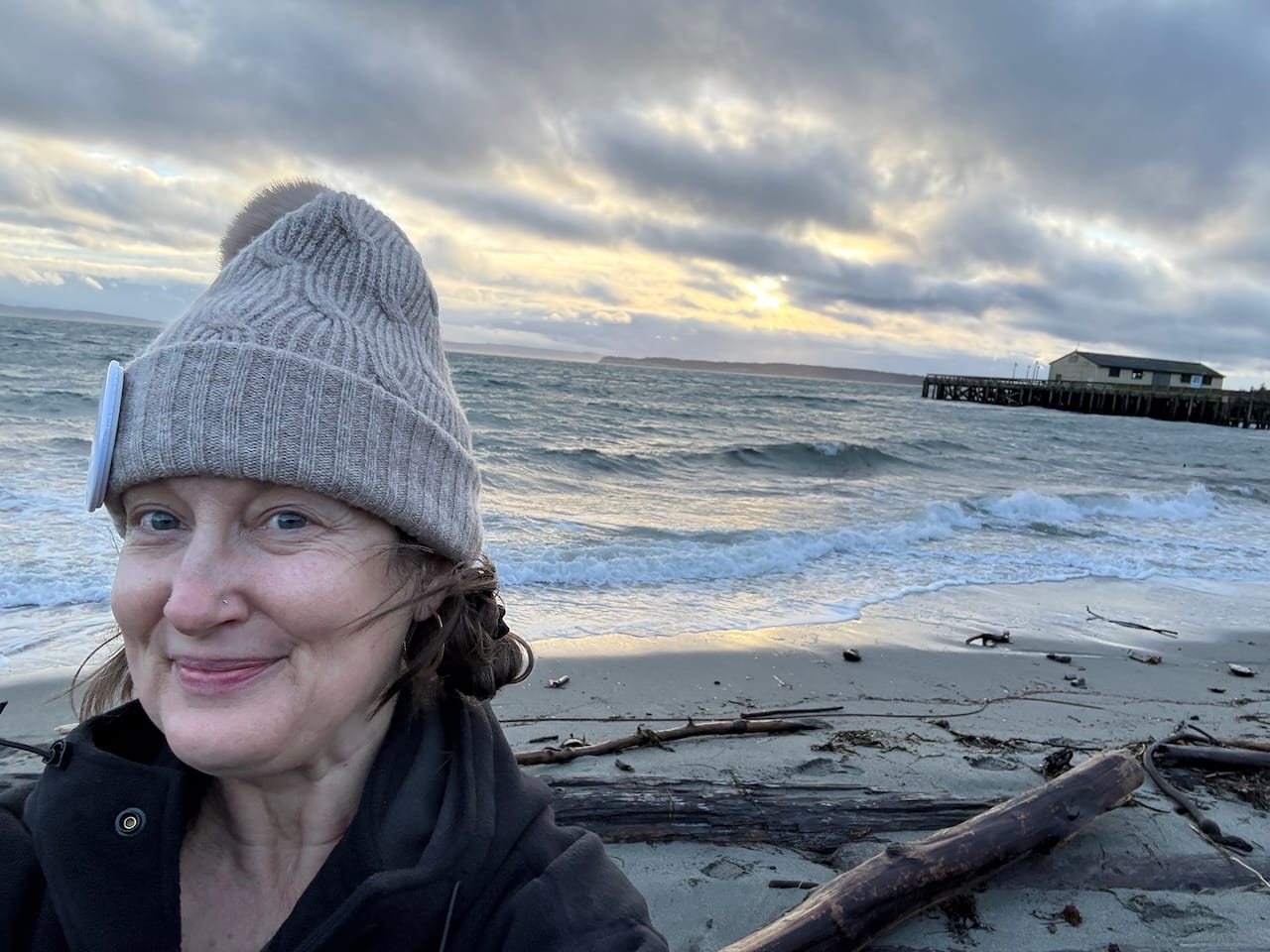
Going to the sea is rather like this. I began to plunge at the end of August. James and I never committed to plunging through the winter; we just stayed curious about what would happen next. The photo above is me on the beach before the plunge on December 21, solstice morning, and we did indeed make it through the winter. It turned out that every Sunday morning one of us would be able to say, "Well, we're never sorry after. We're always so happy after. Let's do this thing!" and that was always enough for the other person.
This morning after my first private yoga session of the day – you could do that with me on Zoom, too! – I slipped into my swimsuit. I drove around the peninsula with the top down, wearing a toasty hat, singing along with Waxahatchie. When I got to the beach and walked into the 49 degree sea with a few dozen friends I watched the voice within me that said, as it often does, "Awwww geez, WHY DO I DO THIS?"
I've built the answer into my lived experience: because I'm never sorry after. Because I'm always glad after. Because I feel better in my body, and better about who I am. Like yoga, it helps me know that I can do hard things, that I don't need to be comfortable all the time, and that in fact, I'm often the most vibrantly alive when I'm pushing the edge of what I think I can do, avidly present.
This time in the world is good for this knowledge: we can do hard things. We can face what is uncomfortable and what is hard. Doing so is deeply rewarding. I bet you're doing this already! I hear people tell me about this all the time: they're running. They're getting sober. They're saying no. They're asking for help. They're learning something new at which they feel terrible and persevering anyway. They're doing something that is difficult and not comfortable and amazing.
I wonder what yours is? I wonder how these ideas might be useful to you? If you care to share, I'd love to hear.
Love,
Dahlia
Resources are Love in Action
Cosmic Awe
NASA has just released an additional 12,000 photographs taken by the astronauts on Artemis 2. Here are EarthSky's favorites with a lovely story about the mission; if you haven't dived in yet, this is a beautiful story. Here are space.com's favorites. Here are Scientific American's favorites, with instructions on how to access the rest.
A-Temporal Awe
On Tuesday Nigerian poet, philosopher, and psychologist Báyò Akómoláfé gave a Long Now Talk entitled The Untimely. The Long Now says that, "perhaps his most pressing meaning can be discerned from the scandalous question he asks: 'What if time misbehaves?' What if time - far from being a simple line that carries on into steady futures through mediating nows and exhausted pasts - careens off the highway, swirls into circuitous paths, and produces monstrous bodies that the imperial tick-tock cannot metabolize?" It was an incredible thing to watch unfold, this poet-philosopher making meaning, slowly, intimately, collectively. Thanks to James
How Exercise Repairs the Brain
We have known for a long time that exercise benefits the brain in ways that protect against Alzheimer's and a recent study published in Cell may reveal why. Gretchen Reynolds summarized this with grace: "In rodents and people, the blood-brain barrier — a narrow layer of cells that protects the brain from toxins and pathogens — typically weakens with age, contributing to neuro-inflammation and other problems, including heightened risks for dementia. But the study’s authors found that during and after exercise, at least in mice, the liver releases a specialized protein that travels to the brain and helps repair the protective cellular barrier there." Thanks to Aimee
Resistance is Love in Action
Oh, the News
In this time in which media consolidation and capitulation is lessening my trust in institutions I have long respected I've found myself searching for new resources to stay informed and expand my mind in a way that is not emotionally brutalizing. I've found three sources useful for this: WTFJHT/What The Fuck Just Happened Today? is a one-sentence daily US news summary which comes out at about 3pm daily. Ground News is a news aggregator and media literacy platform; they aim to provide context and transparency about news coverage. They present how events are being covered on the left, center, and right, with information about the bias, factuality, and ownership of news sources. Tangle says that they are "Unbiased political news from start to finish. We summarize the best arguments from the left, right and center on one big debate every day — then our take." The first piece I read was about abortion rights. I was initially appalled to hear the reporter identify herself as pro-life. I respected having that information as I read her reporting and was astonished to read her boss's addition to the piece in which he, who is pro-choice, noted where he disagreed with her and why. Tangle is a new one for me this week; so far I'm intrigued and impressed. The days of aiming for objective journalism seem behind us, and hearing biases up front is fascinating and refreshing.
How to Start Doing Something
After 9 years of reporting the news, Matt Kiser of WTFJHT has created a "normal person's guide to civic action" which seems like a great starter resource. He calls it Do Something.
Blue Voter's Guide
I believe that I have only missed one opportunity to vote since I become eligible, but when I was young I would sometimes only vote the top of my ballot, the parts that I could recognize easily. Time has shown me, and I think, lots of us, how vital downballot voting is, too: the local roles that decide what happens near to us and which chooses who gains experience and power to work their way toward the top of the ballot. It can be hard to research every issue and race, though! Here's a resource that looks great for helping get informed: The Blue Voter's Guide. Thanks to Jess Craven
Supporting me in supporting you
This is entirely human work – my work, done by hand, with my own mind and heart. I do not use AI in the creation of what I offer you. I don't have one. The half day I devote to creating this each week is a labor of love for which I earn about $15/hr. You can chip in on giving me a raise! You could make a one-time donation of any size, or upgrade to a paid subscription for as little as $5/month.
If you shop at Bookshop.org from links in this newsletter or my bookshop I will receive a commission of 10%. If you buy any book after starting at my shop I'll receive a commission even if those books aren't in my shop.
Sharing my newsletter is a gift too!
If you are a supporter, thank you; I am honored and humbled by your willingness to support my work in the world, and you have put food on my table.